fapilogYour sinks can be slow. Your app shouldn't be.
Async-first structured logging for Python—built to be the perfect companion for FastAPI microservices.
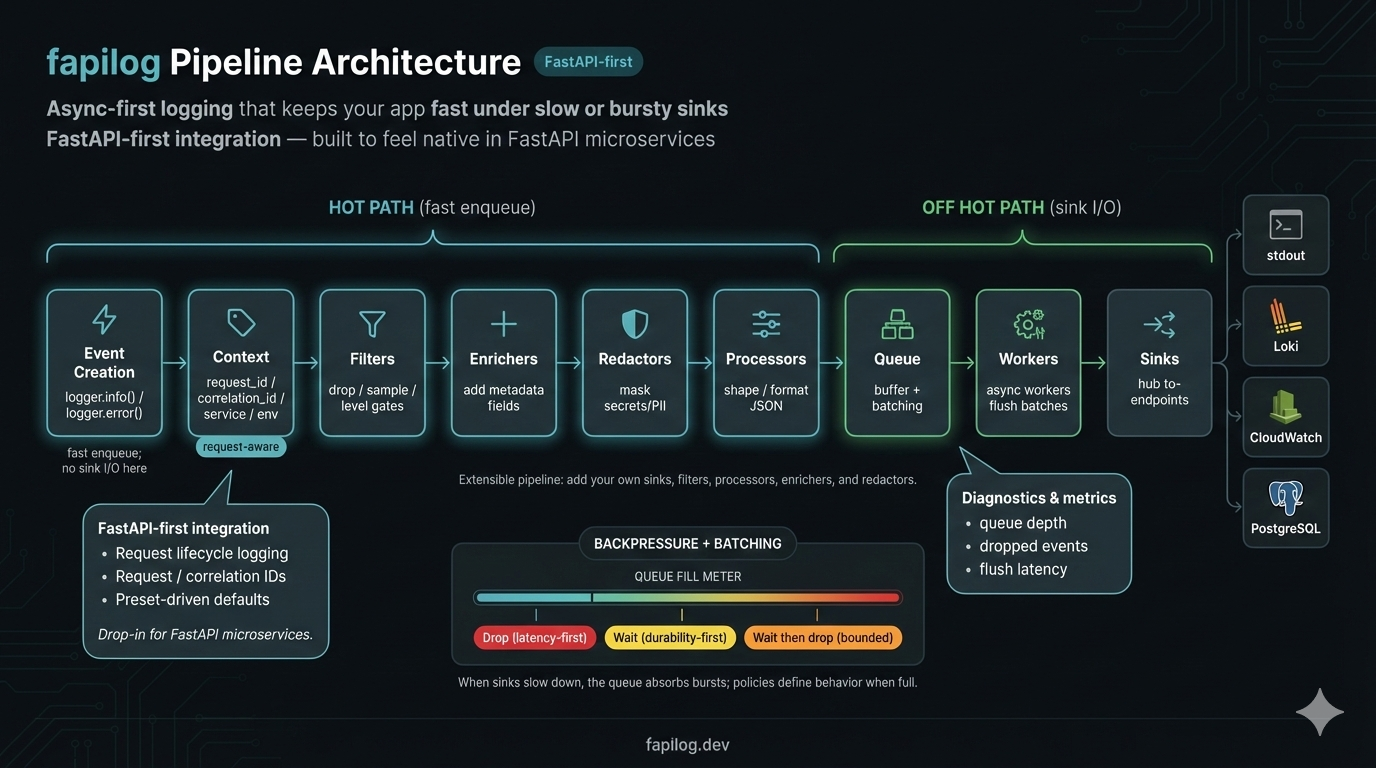
fapilog pushes log I/O off the hot path, applies controlled backpressure, and ships with production-ready redaction.
FastAPI-first. Works everywhere Python runs.
pip install fapilogQuick Start
Get structured logging in your FastAPI app in under a minute.
from fastapi import Depends, FastAPI
from fapilog.fastapi import FastAPIBuilder, get_request_logger

app = FastAPI(
    lifespan=FastAPIBuilder()
        .with_preset("production")
        .build()
)
# Automatically logs every request (method, path, status, latency) with correlation_id for tracing

@app.get("/users/{user_id}")
async def get_user(user_id: int, logger=Depends(get_request_logger)):
    await logger.info("Fetching user", user_id=user_id)
    return {"user_id": user_id}
See the full quickstart guide for more examples.
Why fapilog?
Latency stays stable
Log work is queued; sinks happen off the hot path. Slow destinations don't block your request handlers.
Structured JSON logging
Every log entry is a structured JSON object. Perfect for log aggregators, search, and analysis.
FastAPI-first integration
Designed to be the default logger for FastAPI microservices. Request logging and correlation IDs without boilerplate.
Predictable under overload
Choose your backpressure policy: prioritize latency or durability when logs arrive faster than sinks can write.
Production-ready safety
Built-in PII redaction masks sensitive data automatically. Clean shutdown drains queues so logs aren't lost.
Cloud-native sinks
Native integrations for CloudWatch, Loki, PostgreSQL, and stdout. Route logs where they need to go.
Extensible pipeline
Bring your own sinks, filters, processors, enrichers, and redactors. No marketplace—just clean extension points.
Request correlation
Automatic correlation IDs track requests across your distributed system. Trace issues end-to-end.